By Steven Reid · Last updated on September 23rd, 2026
This post contains affiliate links. As an Amazon Associate I earn from qualifying purchases, at no extra cost to you.
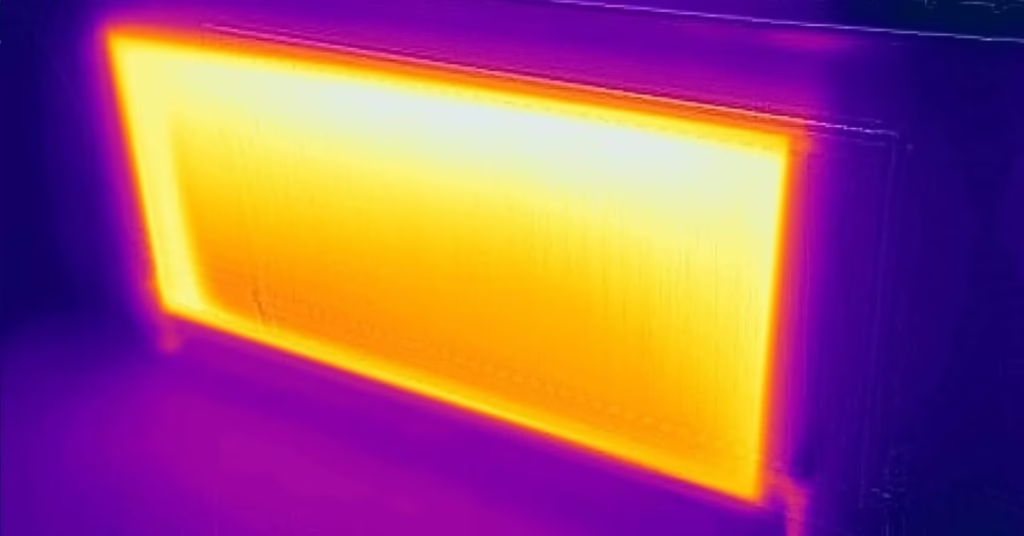
A thermal imaging camera shows surface temperatures, making it useful for tracing hot pipes, checking radiators, finding heat loss and spotting temperature patterns that could point to leaks or other problems.
I use thermal cameras regularly for heating and plumbing work and have tested several different types, so this guide combines hands-on experience with product research to compare the best thermal imaging cameras for different budgets and uses. You can also see more of my recommendations in my best plumbing tools guide.
Best thermal imaging cameras: quick picks
The best thermal imaging camera depends on your budget and how you plan to use it. Here are my top picks based on hands-on experience, product specifications and research.
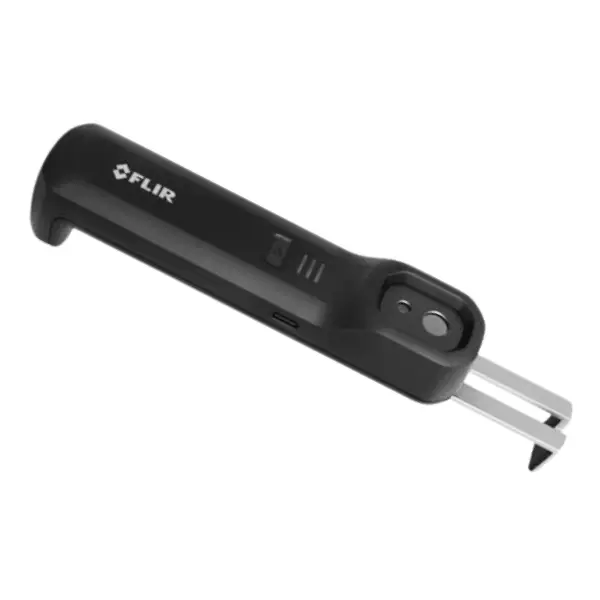 Flir Edge Pro
Wireless design, Android and iPhone compatibility and the ability to inspect awkward or hard-to-reach areas.
View Edge Pro on Amazon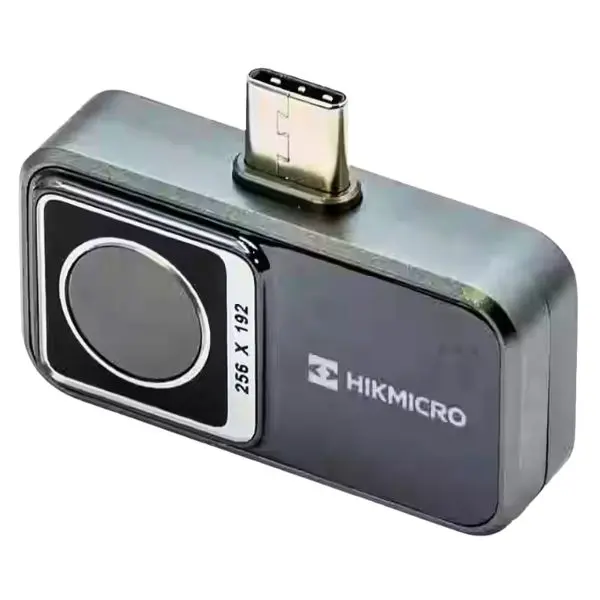 HIKMICRO Mini2 V2
High native resolution in a compact plug-in camera, making it a strong lower-priced option for Android users.
View Mini2 V2 on Amazon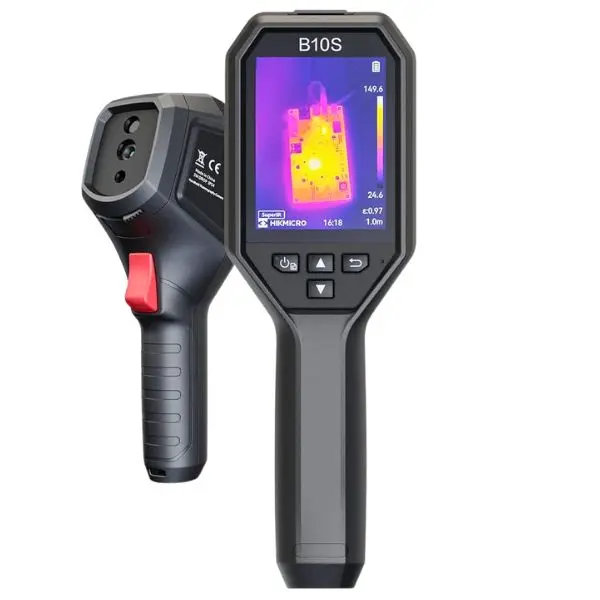 HIKMICRO B10S
A standalone handheld thermal camera with no phone connection required, making it suitable for frequent inspections.
View B10S on Amazon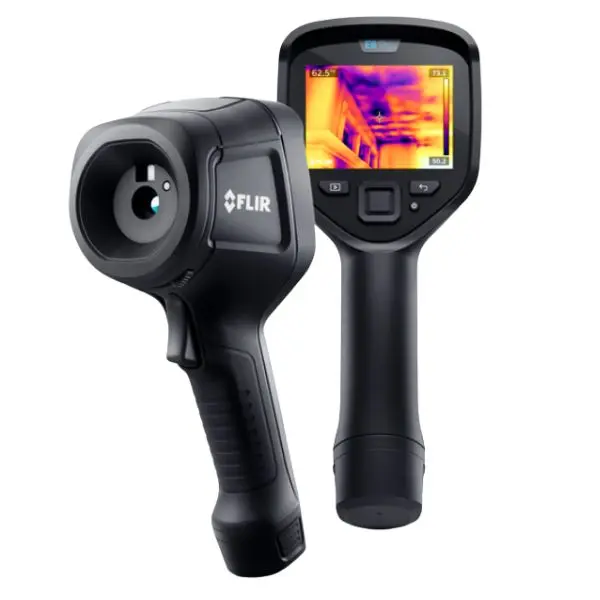 Flir E6 Pro
A professional handheld model with Flir image enhancement, built-in reporting features and a rugged design.
View E6 Pro on AmazonBest thermal camera for Android
The Flir Edge Pro is my top thermal camera for Android. I have used it many times on heating systems, and its wireless design is the main reason I rate it so highly. The camera connects to a compatible phone or tablet without being plugged in, so both can be positioned separately.
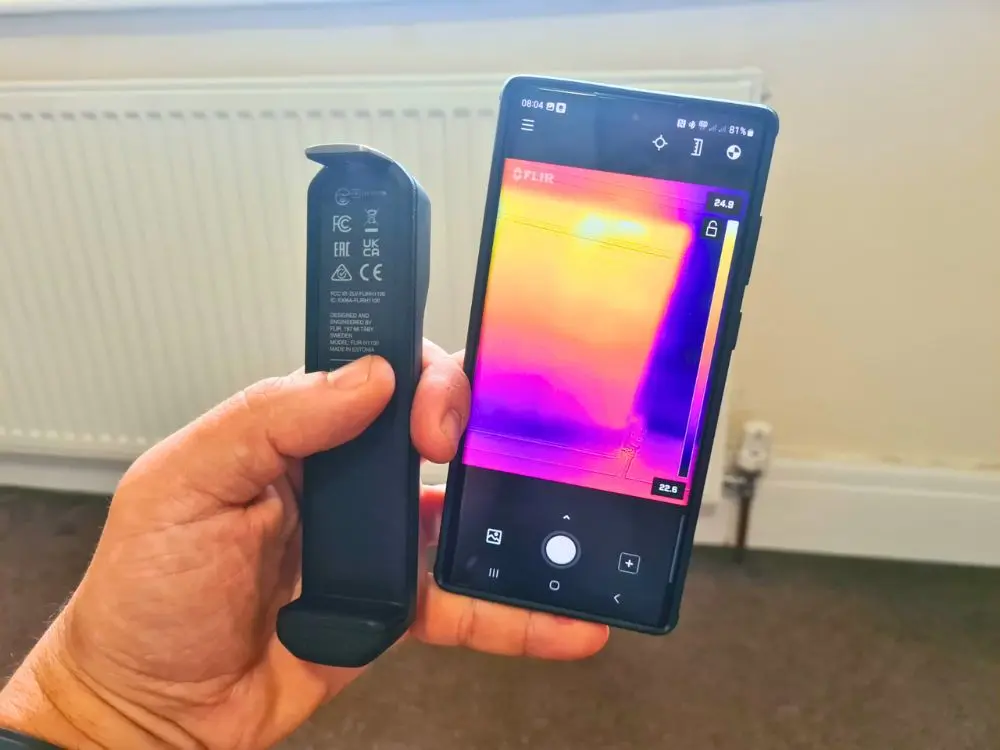
That makes it useful for checking behind radiators, beneath units and in other awkward spaces. It can also clip onto the phone when one-handed use is easier.
The Edge Pro has a 160 × 120 native thermal resolution and uses Flir’s MSX technology to make pipes, radiators and building features easier to recognise. It costs more than a basic plug-in camera and needs its own battery charged, but the wireless design makes it my best overall choice.
Best cheaper thermal camera for Android
The HIKMICRO Mini2 V2 is the better-value alternative. It plugs directly into a compatible Android phone and has a higher 256 × 192 native thermal resolution, along with thermal sensitivity below 40 mK.
It is compact enough to keep in a tool bag and does not need a separate battery. The trade-off is that the camera remains physically attached to the phone while scanning, making it less convenient in confined or hard-to-reach areas.
The Mini2 V2 also works with compatible iPhones. It supports USB-C iPhones and includes an adapter for older Lightning models.
Do these thermal cameras work with iPhone?
Yes. Both the Flir Edge Pro and HIKMICRO Mini2 V2 work with compatible iPhones. The Flir connects wirelessly, while the Mini2 V2 plugs directly into the phone. Check the manufacturer’s compatibility list before buying, particularly when using an older phone.
Best budget thermal imaging camera
The HIKMICRO Mini2 V2 is my best budget pick. It offers a 256 × 192 native thermal resolution, a smooth 25 Hz refresh rate and thermal sensitivity below 40 mK, which is impressive for such a compact phone-connected camera.
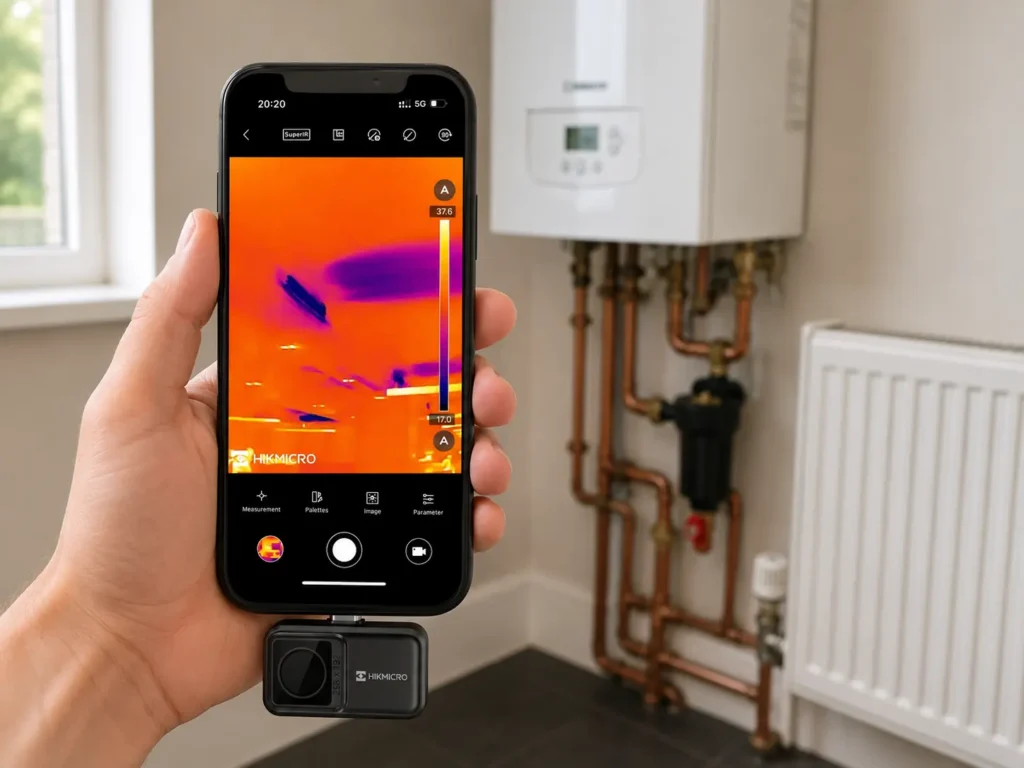
It plugs directly into a compatible Android phone or iPhone and uses the phone’s screen and battery, so there is no separate unit to charge. It is small enough to keep in a tool bag and should provide enough detail for checking radiator heat patterns, tracing pipes and spotting unusual temperature differences.
The main drawback is that it stays physically attached to the phone while in use. This makes it less convenient than the wireless Flir Edge Pro when inspecting behind radiators or in confined spaces.
Best budget alternative
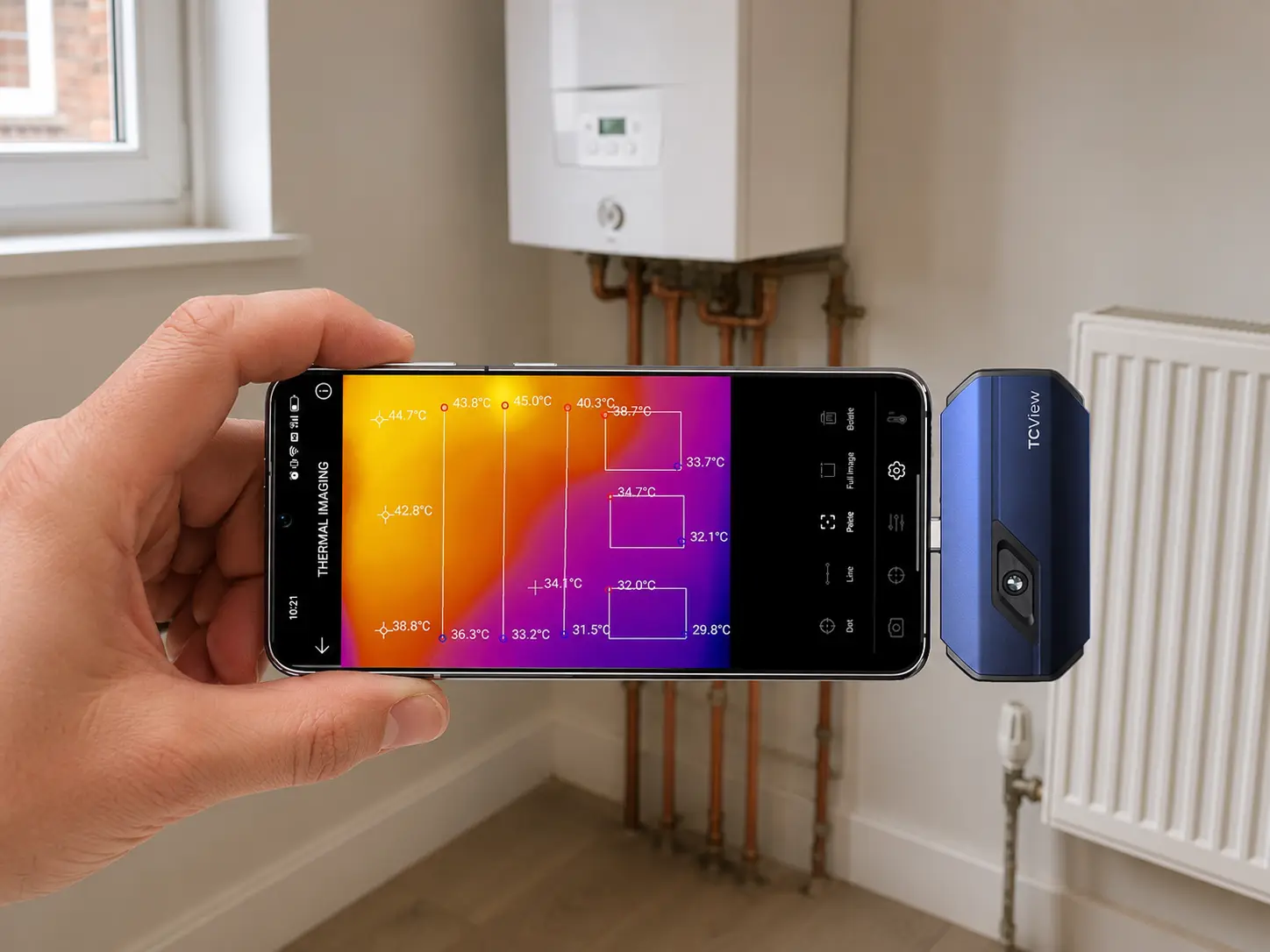
The TOPDON TC001 is another strong lower-priced option, particularly for Android users. It also has a 256 × 192 thermal resolution and works with Android phones, tablets and Windows computers.
It offers good image quality for the money, but the standard TC001 does not support iPhone, which makes the HIKMICRO Mini2 V2 the more versatile choice overall.
Best Flir thermal cameras
Flir is one of the best-known thermal-imaging brands, with options ranging from compact phone attachments to professional handheld cameras. The Flir Edge Pro is my favourite all-round model, while the Flir One Pro suits anyone who wants a direct phone connection and the Flir E6 Pro is designed for more frequent professional inspections.
Flir Edge Pro
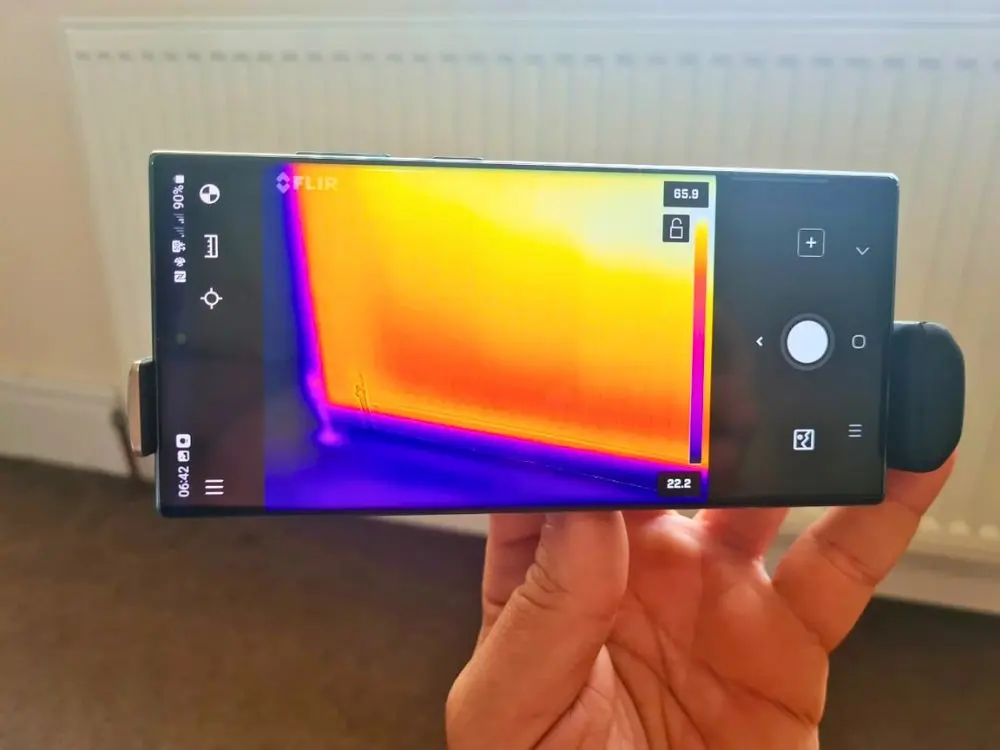
The Flir Edge Pro is my top Flir thermal camera and my best overall choice in this guide. I have used it many times on heating systems, and its wireless design is what sets it apart from standard phone attachments.
It connects wirelessly to compatible Android and iOS devices, allowing the camera and phone to be positioned separately. This is useful when inspecting behind radiators, beneath units or in other areas where it would be awkward to hold the phone and camera together. It can also clip onto the phone for one-handed use.
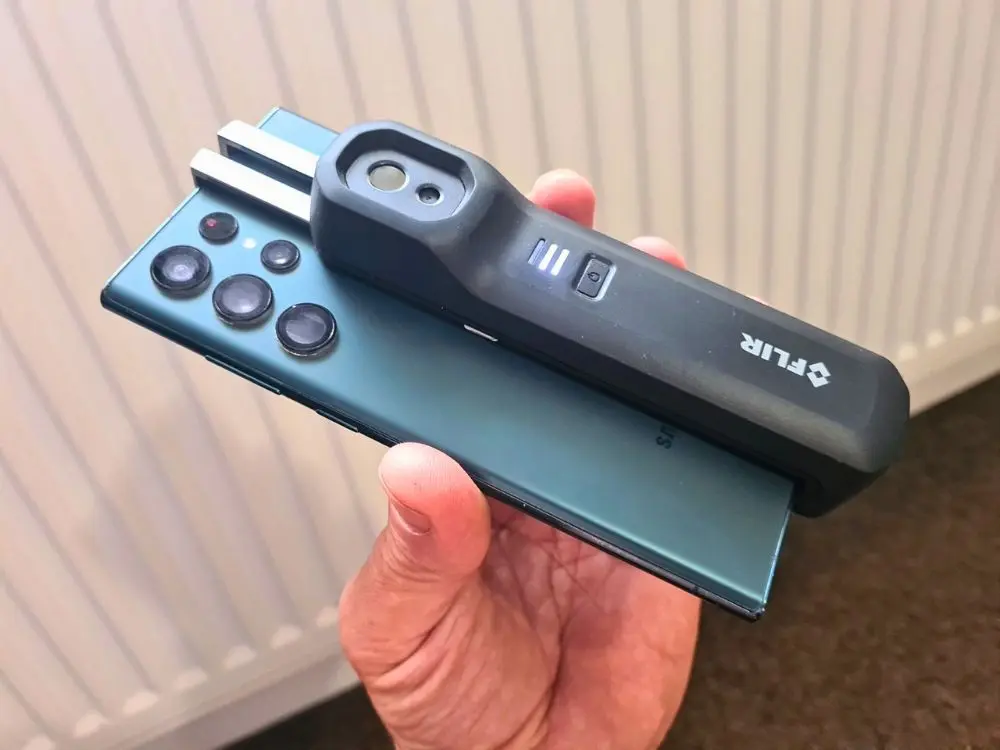
The Edge Pro has a 160 × 120 native thermal resolution and uses Flir’s MSX and VividIR image processing to make objects and heat patterns easier to recognise. It also has a battery life of up to 2.5 hours, IP54 protection and a two-metre drop-test rating.
Its main disadvantages are the higher price and the need to charge a separate battery. However, the freedom to position it away from the phone makes it the most versatile Flir option for heating, plumbing and home inspections.
Flir C5 Compact
The Flir C5 is a compact standalone thermal camera for anyone who wants a dedicated device without moving up to a larger professional handheld model. Its pocket-sized design makes it easy to carry between jobs, while the touchscreen keeps it straightforward to use without connecting it to a phone.
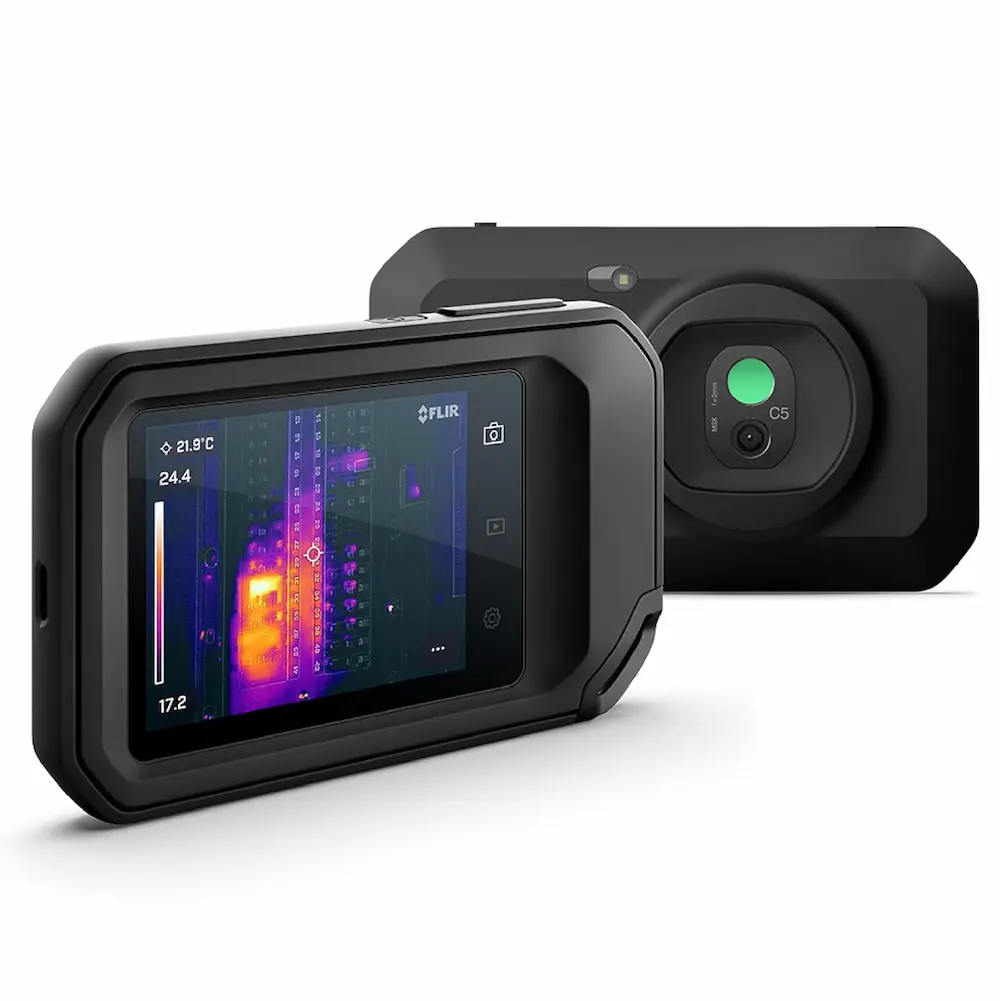
It has a 160 × 120 thermal resolution, a 5 MP visual camera and Flir’s MSX technology, which adds visible detail to thermal images so pipes, radiators and building features are easier to identify. It also includes Wi-Fi and Flir Ignite cloud connectivity for storing, organising and sharing inspection images.
The C5 is rated IP54, designed to withstand a two-metre drop and provides around four hours of battery life. Its main limitation is that its thermal resolution is no higher than the Edge Pro, despite costing more. However, it is a better choice for users who prefer a rugged, self-contained camera rather than relying on a phone.
Flir E6 Pro
The Flir E6 Pro is the best premium Flir camera included in this guide. It is a standalone handheld model, so it does not require a phone and is better suited to regular professional inspections.
Its 240 × 180 thermal resolution provides substantially more native thermal detail than the Edge Pro and One Pro. It also has a 5 MP visual camera, a 3.5-inch touchscreen and Flir’s MSX image enhancement.
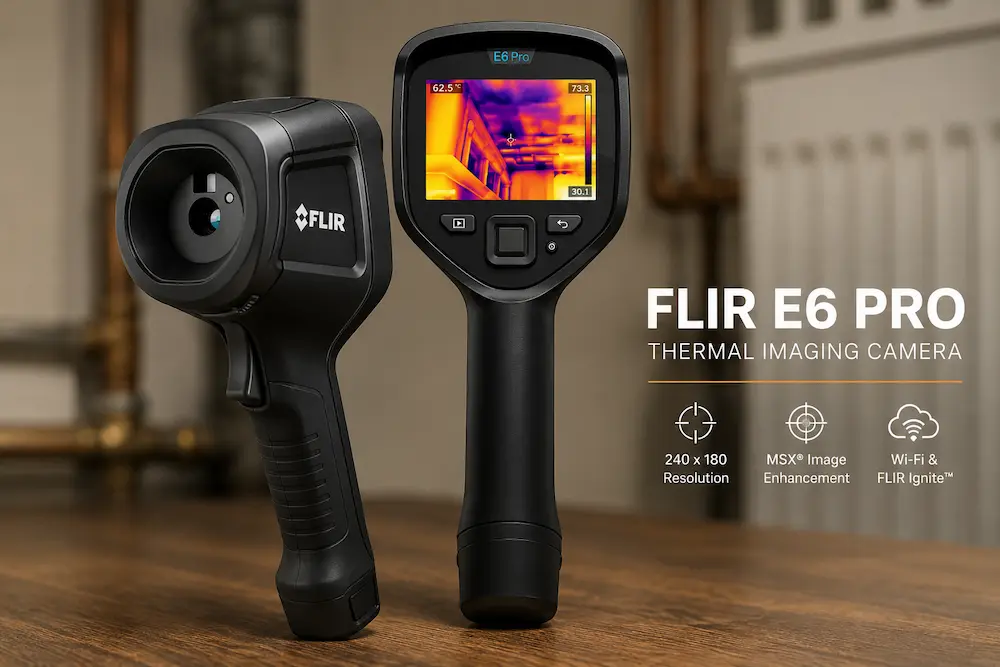
Images can be organised, annotated and uploaded directly to Flir Ignite over Wi-Fi, which is useful for storing inspection records or creating reports for customers. The rugged point-and-shoot design also makes it quicker to pick up and use than a phone-connected camera.
The E6 Pro is considerably more expensive than the mobile models, so it is difficult to justify for occasional radiator or household checks. It makes more sense for professionals who use thermal imaging regularly and value the higher resolution, dedicated controls and reporting features.
Which Flir thermal camera should you buy?
For most plumbers, heating engineers and home users, I recommend the Flir Edge Pro because its wireless design makes it easier to use in awkward areas.
Choose the Flir One Pro when you want a cheaper direct phone attachment and do not mind selecting a model specifically for your phone’s operating system and connector.
The Flir E6 Pro is the better choice for frequent professional inspections where its higher thermal resolution, standalone design and reporting features can justify the extra cost.
What can you use a thermal imaging camera for?
Thermal imaging cameras are useful anywhere temperature differences can reveal a problem. Common uses include:
- Heat loss: Finding cold spots around walls, windows, doors and areas with poor or missing insulation.
- Home and building inspections: Checking ceilings, floors and walls for unusual temperature patterns.
- Electrical inspections: Spotting overheating connections, breakers and other electrical components.
- Moisture detection: Damp areas can sometimes appear cooler because of evaporation.
- HVAC checks: Comparing temperatures across vents, ducts and heating or cooling equipment.
- Underfloor heating: Seeing pipe layouts and identifying areas that are not heating evenly.
- Heating and plumbing: Checking radiators, tracing heating pipes and narrowing down possible hidden leaks.
They do not see through walls. Instead, they show surface temperature differences, which can help point you towards the source of a problem.
What to look for in a thermal imaging camera
The best thermal imaging camera depends on how often you’ll use it and how much detail you need. The main things I’d compare are:
- Thermal resolution: Higher resolution gives a more detailed thermal image. A 256 × 192 sensor will normally show smaller temperature differences more clearly than a 160 × 120 sensor.
- Thermal sensitivity: Usually shown as mK. A lower number means the camera can detect smaller temperature differences, which is useful for heat loss, moisture and leak detection.
- Temperature range: Most home and trade users do not need an extreme range, but it matters more for electrical, mechanical and industrial inspections.
- Phone or handheld design: Phone cameras are compact and usually cheaper, while standalone handheld models are more convenient for frequent professional use.
- Android and iPhone compatibility: Check the connection type carefully if you’re buying a phone-mounted camera, especially USB-C or Lightning compatibility.
- Wireless or plug-in connection: Wireless cameras such as the Flir Edge Pro can be easier to position in awkward areas than a camera fixed directly to the phone.
- Battery life and durability: More important if you’ll be using the camera regularly on site rather than occasionally around the home.
For most people, I’d prioritise image quality, thermal sensitivity and ease of use over chasing the highest possible temperature range.
Thermal camera FAQs
Can a thermal camera see through walls?
No. It displays the surface temperature of the wall, which may reveal patterns caused by pipes, missing insulation or moisture.
Can a thermal camera find a water leak?
It can identify hot or cold patterns that may indicate a leak, but it does not directly detect water. Further checks may be needed.
Can a thermal camera detect sludge in a radiator?
It can show uneven heat distribution, including colder areas that may be associated with restricted circulation or sludge. The image alone does not confirm the cause. Read how flushing a central heating system can remove sludge and improve circulation.
What thermal resolution is best for a thermal imaging camera?
A 160 × 120 sensor is suitable for many everyday checks, but 256 × 192 gives noticeably more detail. Higher resolution is especially useful for smaller targets, subtle temperature differences and more detailed inspections.
Is a phone thermal camera as good as a handheld camera?
Phone cameras offer excellent portability and value. Standalone cameras normally provide a more durable, convenient workflow for frequent professional inspections.
Does the FLIR Edge Pro work with Android and iPhone?
Yes, it connects wirelessly to compatible Android and iOS devices rather than relying on a specific physical connector.
Can thermal imaging detect heat loss?
Yes. Thermal cameras can highlight colder areas around walls, windows, doors and insulation gaps where heat may be escaping. They show surface temperature differences rather than measuring heat loss directly.
Final thoughts
The Flir Edge Pro is my top overall pick because the wireless design makes it especially useful for checking awkward areas, and it works with both Android and iPhone. The HIKMICRO Mini2 V2 is a strong compact option, while the TOPDON TC001 offers good value for Android users.
For a dedicated handheld thermal camera, the HIKMICRO B10S is a good all-round choice, while the Flir E6 Pro is better suited to more frequent professional inspections.
For heating work, thermal imaging is particularly useful when diagnosing uneven radiator temperatures and circulation problems. If that’s what you’re investigating, see my guide to why a radiator is not heating up.