By Steven Reid · Last updated on September 5th, 2026
This post contains affiliate links. As an Amazon Associate I earn from qualifying purchases, at no extra cost to you.
Knowing how to stop your boiler condensate pipe freezing can prevent your boiler from breaking down and leaving you without heating or hot water in winter.
I have been a full-time heating engineer for over 15 years and fixed many frozen condensate pipe problems. Here I’ll show you the best ways to prevent it, including correct installation, insulation and trace heating.
Why do boiler condensate pipes freeze?
Condensing boilers produce wastewater that runs through a plastic condensate pipe and into a waste pipe, soil pipe or drain. When part of the pipe is exposed to sub-zero temperatures, the water inside can freeze and block it.
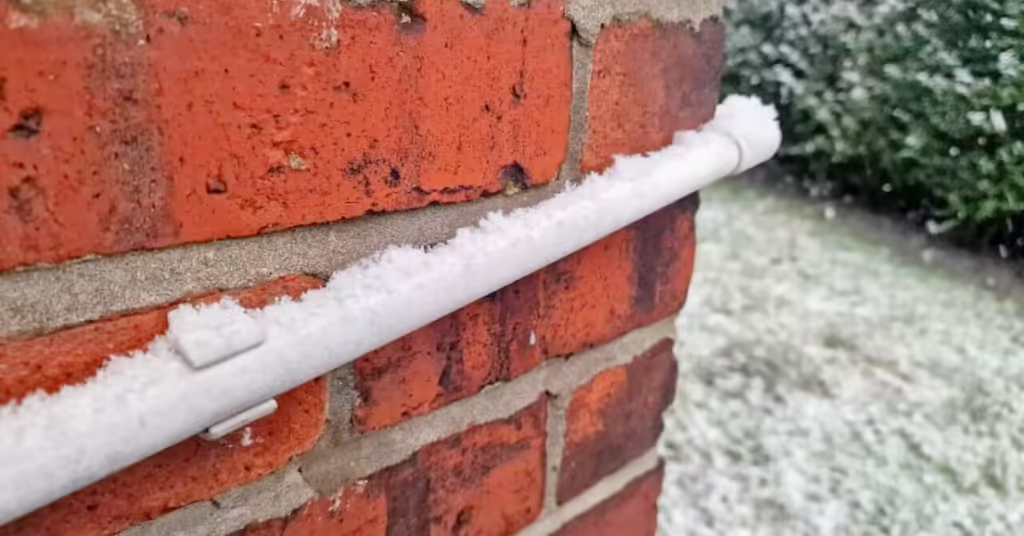
In my experience, most problems happen when the external pipe is too small, too long, fitted horizontally or doesn’t have enough fall. Dips and bends can also hold water, making it much easier to freeze.
Once the pipe is blocked with ice, the wastewater backs up and the boiler stops working. If this has already happened, follow my guide on how to thaw a frozen boiler condensate pipe.
The best way to stop a condensate pipe freezing
The best way to stop a condensate pipe freezing is to keep it inside the property and away from sub-zero temperatures.
The options, in order of preference, are:
- Discharge it by gravity into an internal waste pipe or soil pipe.
- Fit a condensate pump that carries the wastewater to an internal connection.
- Fit a correctly sized external pipe with a short run and continuous fall.
When an external pipe can’t be avoided, it should run inside the property for as long as possible before passing through the wall.
In my experience, insulating a long, undersized horizontal pipe only treats the problem. Correcting the installation is the best permanent solution.
Run the condensate pipe inside
The most reliable way to prevent freezing is to connect the condensate pipe to an internal waste pipe or soil pipe.
Possible internal discharge points include:
- Soil stack pipe
- Kitchen sink waste
- Bath or shower waste
- Washing machine waste
The pipe must have a continuous fall from the boiler so the wastewater can run away freely. It should also be connected correctly to prevent smells or wastewater from backing up towards the boiler.
A strap boss can be used to connect the condensate pipe to a soil stack. See my guide on how to fit a strap boss to a soil pipe.
Condensate pump
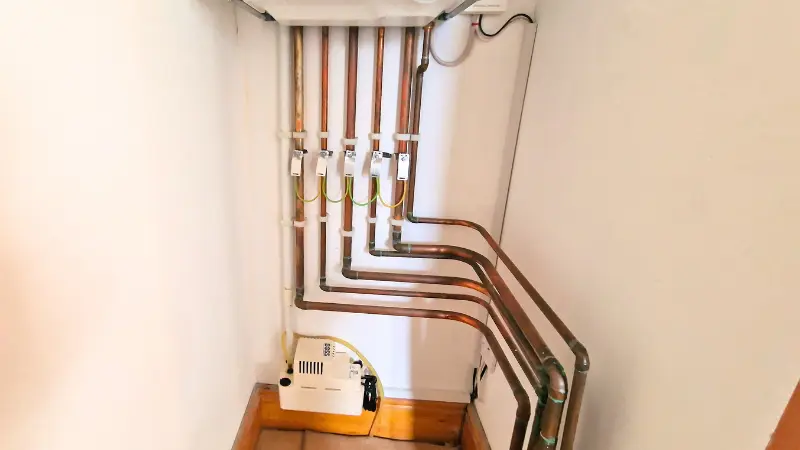
If the pipe can’t run downhill to an internal waste, a condensate pump can be fitted near the boiler.
The pump collects the wastewater and automatically pumps it to a suitable connection. This allows the pipe to travel upwards or around obstacles while keeping the discharge inside the property.
Recommended way to fit an external boiler condensate pipe
If a condensate pipe has to go outside, how it is fitted will have the biggest effect on whether it freezes.
An external condensate pipe should:
- Run inside the property for as long as possible
- Increase to at least 30 mm internal diameter before passing through the wall
- Use 32 mm waste pipe or larger outside
- Have a continuous fall with no dips or horizontal sections
- Be kept as short and vertical as possible
- Have as few bends and fittings as possible
- Terminate below the drain grating but above the water level
- Be securely clipped and supported
Pipework in an unheated loft, garage or basement should be treated as external pipework because it can still freeze.
Always check the boiler manufacturer’s instructions, as requirements can vary between boilers. You can also read the HHIC condensate discharge pipe guidance for recommended installation methods.
Use heat from the heating flow pipe
When fitting a condensate pipe, I run the internal section alongside the boiler’s heating flow pipe where possible. This warms the condensate pipe whenever the heating is running and raises the temperature of the wastewater before it passes outside.
A Worcester Bosch CondenseSure uses the same principle. It clips onto the 22 mm heating flow pipe and uses the heat to warm the condensate before releasing it through the discharge pipe.
It requires no electricity or moving parts and can be fitted to new or existing condensing boilers. However, it should provide additional frost protection rather than compensate for an undersized pipe, poor fall or unnecessarily long external run.
How to insulate a boiler condensate pipe
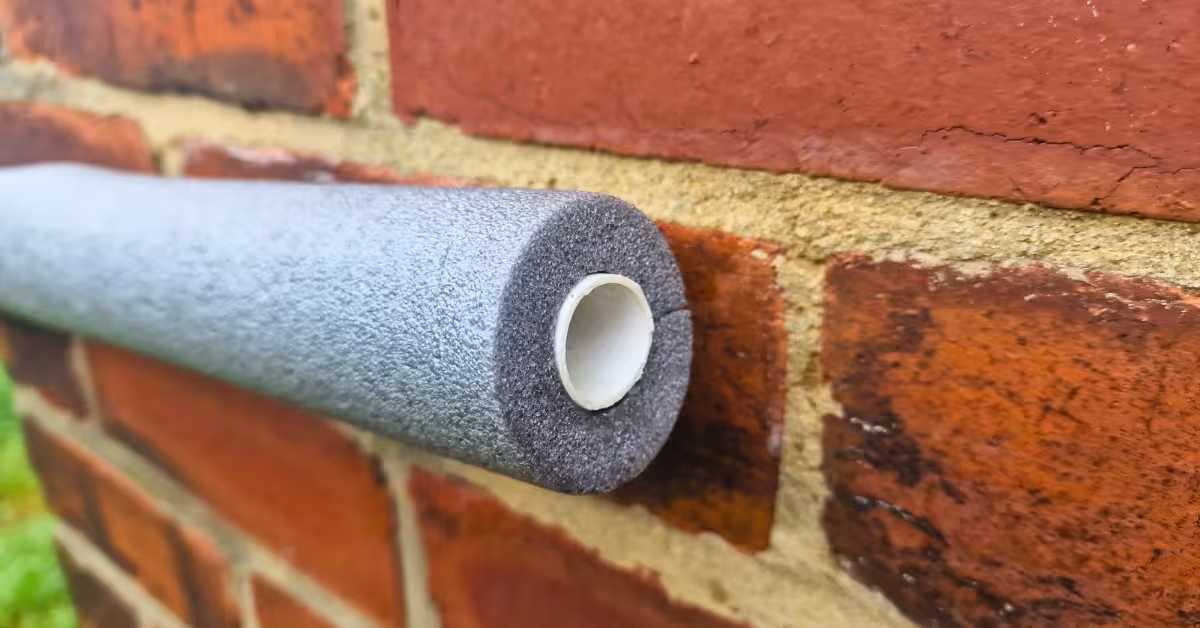
Insulating an external condensate pipe slows down heat loss and reduces the chance of the wastewater freezing. It is especially important on exposed walls and pipes that have frozen before.
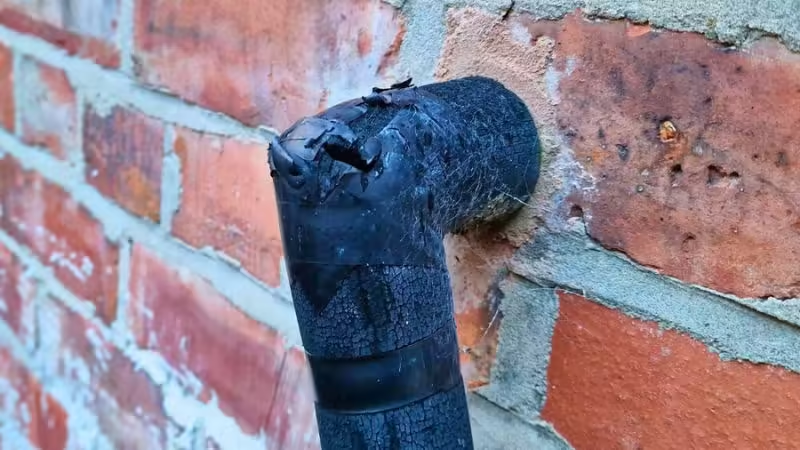
Insulation will not fix an undersized pipe, a poor fall or water sitting in a dip. Correct these problems first whenever possible.
Best condensate pipe insulation
Use thick, closed-cell pipe insulation suitable for outdoor use. It should fit tightly around the pipe and resist water because wet insulation will offer very little frost protection.
For a 32 mm external waste pipe, I recommend using 35 mm Armaflex pipe insulation.
How to fit the insulation
- Measure the outside diameter of the condensate pipe.
- Choose insulation with the closest matching internal diameter.
- Cover every section of pipe exposed to cold weather.
- Push the insulation tightly against the external wall.
- Seal every joint, bend and cut with suitable weatherproof tape.
- Make sure the end of the condensate pipe remains open and unrestricted.
Avoid leaving small gaps between pieces because these sections can still freeze.
Insulating an undersized pipe
Many older external condensate pipes are approximately 21.5 mm or 22 mm. Insulation can help protect them, but increasing the external pipe to 32 mm is a better permanent solution.
If replacing the pipe isn’t currently an option, 22 mm Armaflex pipe insulation can provide additional frost protection.
Condensate pipe trace heating
Trace heating uses an electric heating cable to keep the condensate pipe above freezing during cold weather. It is one of the most effective ways to protect an external pipe that can’t be rerouted inside.
The cable should be suitable for plastic pipework and is normally fitted along the external condensate pipe before being covered with insulation.
How trace heating works
A self-regulating trace heating cable changes its heat output depending on the temperature. It produces more heat as the pipe gets colder and reduces its output as the temperature rises.
Some kits also use a separate thermostat or frost sensor to control when the cable operates.
When to fit trace heating
Trace heating is worth considering when:
- The condensate pipe has frozen more than once
- A long section of pipe has to run outside
- The pipe is exposed to strong winds
- Rerouting the pipe inside isn’t practical
- Insulation hasn’t provided enough protection
It should support a correctly fitted condensate pipe rather than compensate for an undersized pipe or poor fall.
Fitting trace heating
The cable must be secured to the pipe according to the manufacturer’s instructions and covered with suitable external pipe insulation. Do not overlap or cross the cable unless the manufacturer confirms it is safe.
Any permanent electrical connection should be completed by a suitably qualified person.
You can view the condensate pipe trace heating kit I recommend on Amazon. Five metres will suit many domestic installations, but measure the pipe before ordering and choose the closest available length.
Condensate pipe keeps freezing
If your condensate pipe keeps freezing, repeatedly thawing it is not a permanent solution. There is usually a problem with the external pipe or the way it has been fitted.
In my experience, the most common causes are:
- Undersized external pipe
- Long horizontal sections
- Not enough fall
- Dips where wastewater collects
- Poor or damaged insulation
- An exposed pipe end
- A blocked or slow-running drain
Start by checking the pipe size, fall and route. Increasing the external section to 32 mm and shortening it will usually make more difference than adding extra insulation to a poorly fitted pipe.
If possible, reroute the condensate to an internal waste pipe or use a condensate pump. When the external route can’t be changed, combine suitable insulation with trace heating for maximum frost protection.
When to call a heating engineer
Call a heating engineer if:
- The pipe continues to freeze after being insulated
- The external pipe needs rerouting or replacing
- The pipe is too high to reach safely
- Wastewater is backing up or leaking
- The boiler still won’t work after the pipe has thawed
Even a correctly fitted pipe can freeze during prolonged extreme weather, but it should not happen every time the temperature drops below zero.
Have any questions about stopping a condensate pipe from freezing? Leave them in the comments below and I’ll do my best to help. If you found this guide useful, please share it with someone who might need it this winter.