By Steven Reid · Last updated on September 5th, 2026
What a boiler service includes varies slightly between manufacturers and boiler models, but the purpose is always the same: to check that the appliance is working safely and correctly and to carry out any servicing and cleaning it requires.
A service is routine maintenance rather than a repair. If the boiler is already leaking, showing a fault code or not working properly, additional fault finding or repair work may be needed.
I have been servicing boilers full time for almost two decades. In this guide, I’ll show you exactlywhat I include in an annual boiler service, how long it takes and what service record you should receive afterwards.
Boiler service checklist
There is no single identical checklist for every gas boiler. The correct procedure depends on the manufacturer’s instructions, the model, its age and its condition.
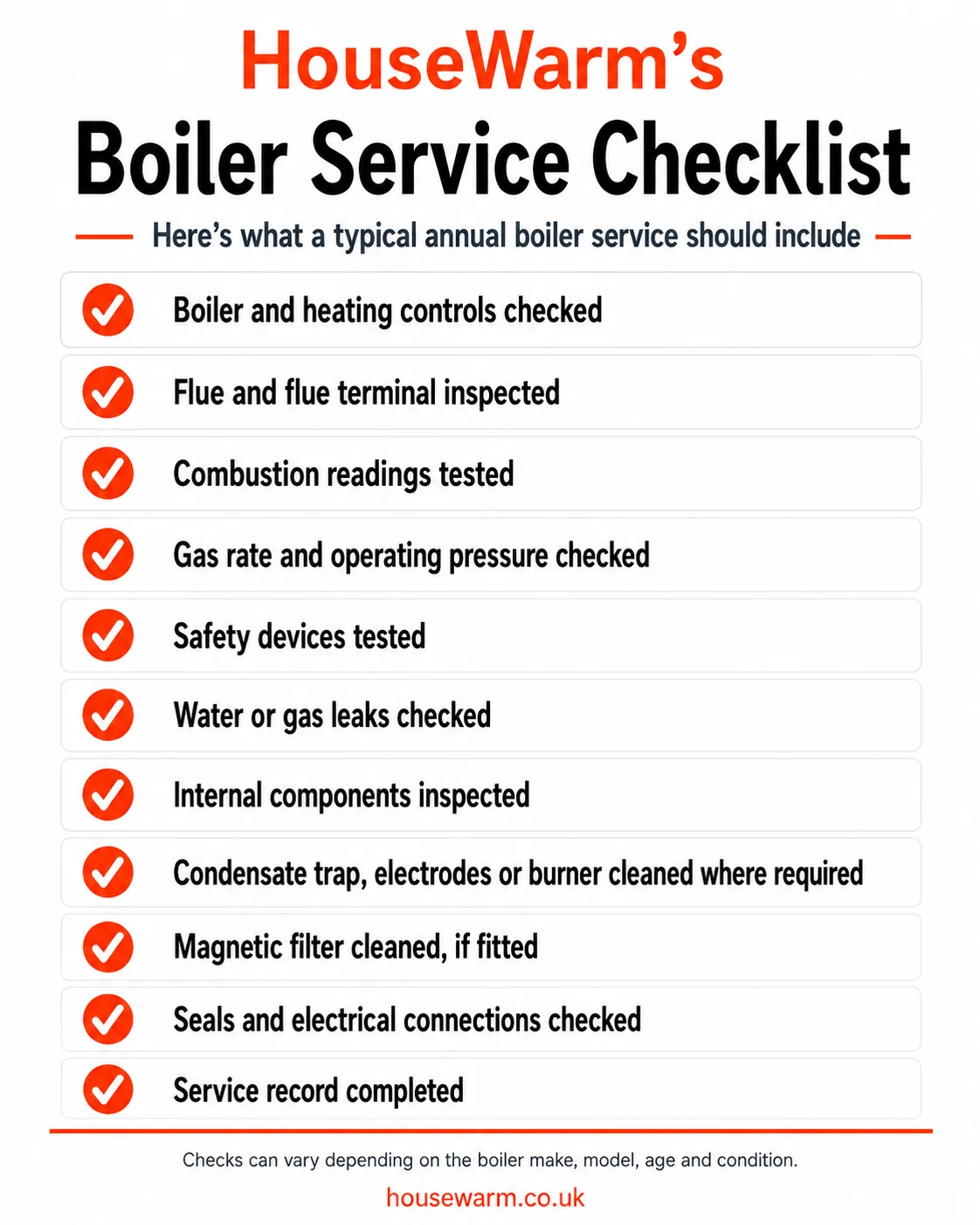
However, a thorough boiler service should include inspection, safety testing and cleaning where required.
A typical boiler service checklist includes:
- Testing the boiler and heating controls
- Inspecting the boiler and surrounding pipework
- Removing the case and checking internal components
- Checking and cleaning components where required
- Inspecting the flue and external flue terminal
- Checking the heat input or inlet pressure
- Testing the combustion readings
- Checking safety devices and case seals
- Looking for water, gas or combustion leaks
- Cleaning the magnetic filter when needed
- Recording the results and any recommendations
The Gas Safe Register explains that a service should include the checks and tests required by the appliance manufacturer rather than exactly the same procedure being applied to every boiler.
Initial boiler and control checks
Before removing the boiler case, I turn on the heating and hot water to confirm that the boiler is working. I also check the thermostat, programmer and other heating controls where applicable.
The initial checks can include:
- Checking the boiler starts and shuts down correctly
- Testing the heating and hot water controls
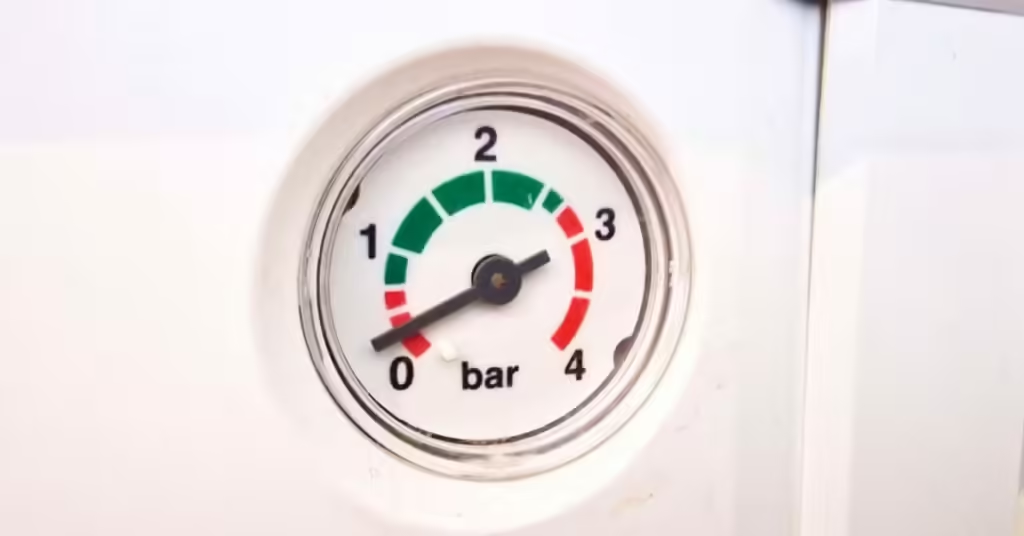
- Checking the system pressure
- Listening for unusual noises
- Looking for visible leaks, corrosion or staining
- Inspecting accessible pipework around the boiler
Low pressure does not necessarily mean the boiler itself is faulty. My guide to why a boiler keeps losing pressure explains the common causes elsewhere in the heating system.
Internal inspection and cleaning
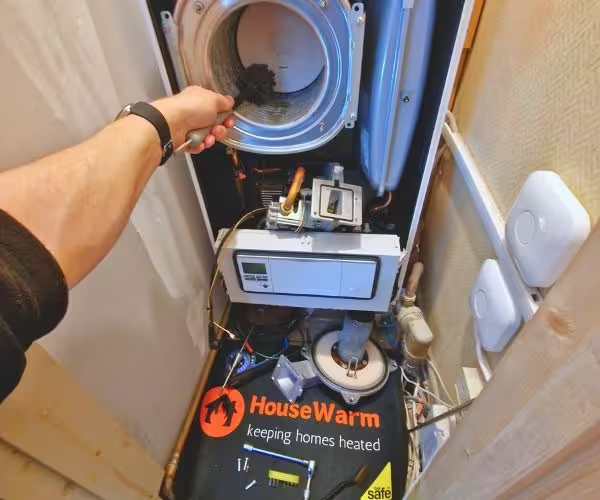
I then turn the boiler off, isolate it as required and remove the case so the internal components can be inspected.
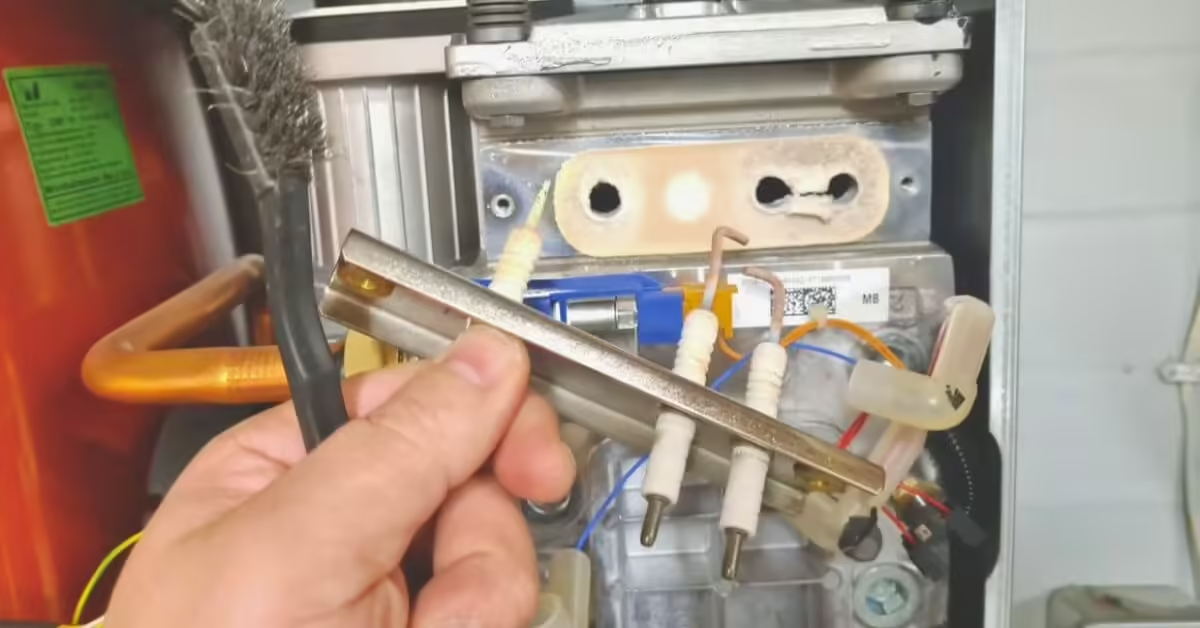
What needs cleaning depends on the boiler and the condition of its parts. This may include the:
- Condensate trap
- Ignition and sensing electrodes
- Burner
- Heat exchanger
- Internal seals and combustion chamber
- Magnetic heating system filter
Components are cleaned only where required and in accordance with the manufacturer’s servicing instructions. It is not necessary or appropriate to dismantle every component during every annual service.
When a magnetic filter is fitted, cleaning it is recommended. Removing the collected sludge helps protect the boiler and also gives an indication of the condition of the system water. Often, there isn’t any sludge in there, this is a good sign the system was flushed properly.
Baxi’s current warranty conditions specifically require the magnetic filter supplied with certain boilers to be maintained, as well as requiring an annual service to keep the full warranty valid.
Combustion, gas rate and flue checks
Once the internal inspection and cleaning are complete, I refit the boiler case and operate the appliance at the required rate.
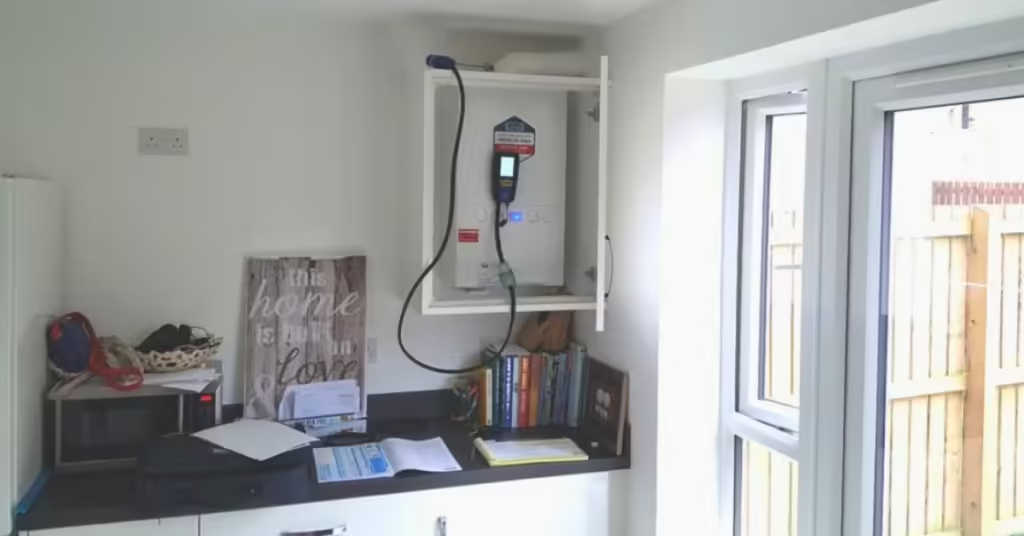
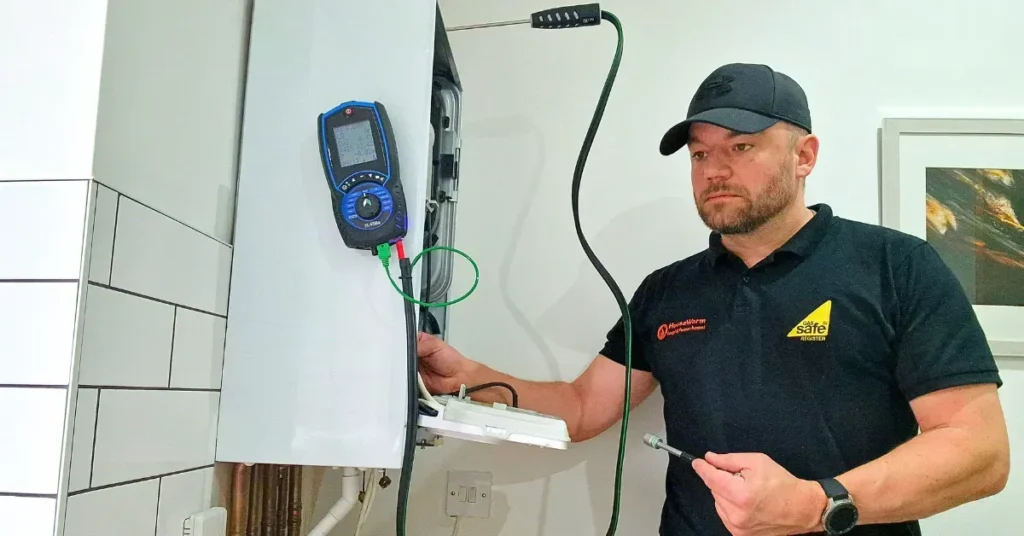
I use a flue gas analyser to test the combustion readings through the boiler’s flue test point. The readings are checked against the acceptable figures in the manufacturer’s instructions.
Depending on the boiler, the checks may include:
- Gas rate or heat input testing
- Maximum rate combustion readings
- Minimum rate combustion readings where required
- Burner operating pressure where applicable
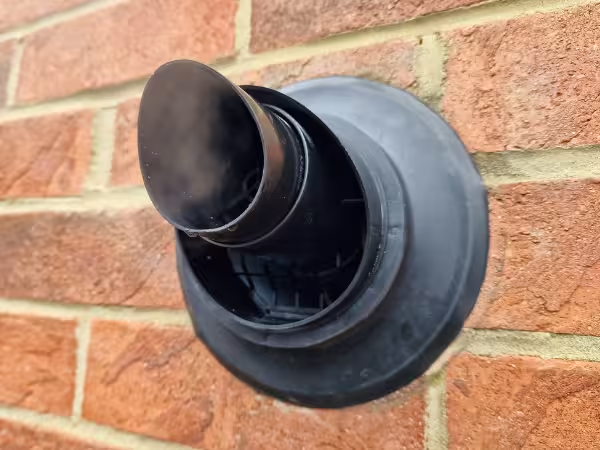
- Inspection of the full flue route
- Inspection of the external flue terminal
If the readings are outside the manufacturer’s permitted range, further investigation or adjustment may be required. Not every modern boiler has a gas valve that can or should be adjusted during servicing.
Final safety and operational checks
After reassembling the boiler, I complete the final safety and operational checks.
These normally include:
- Checking the boiler case and seals are fitted correctly
- Checking electrical connections are secure
- Testing the boiler’s safety devices
- Rechecking the heating and hot water
- Looking for leaks after the boiler has run
- Confirming the controls still operate correctly
- Explaining any faults or recommendations found
I record the relevant details and test results while carrying out the service so the customer has a clear record of what was checked.
What is not included in a boiler service?
A routine boiler service is preventative maintenance. It does not normally include faulty boiler repairs and replacement parts.
The following work is generally separate from a standard service:
- Extended fault finding on a boiler that is not working
- Replacement components
- Repairing water or gas leaks
- Repairing radiators, valves or heating pipework
- Adding inhibitor unless agreed beforehand
- Flushing or cleaning the whole heating system
- Providing a landlord gas safety certificate
- Work on unrelated gas appliances
A minor issue may sometimes be corrected during the appointment, but a faulty boiler can require separate fault finding and repair work.
Similarly, a boiler service does not clean sludge from every radiator and pipe. A particularly dirty system may need separate heating system cleaning.
How long does a boiler service take?
A thorough boiler service will usually take around 45 minutes to an hour.
A straightforward service on a relatively new boiler installation in good condition may take around 45 minutes. An older boiler, restricted access, extra cleaning or unusual combustion readings can make the service take longer.
The main factors are:
- Boiler make and model: Some boilers have more serviceable parts or additional checks.
- Age and condition: Older or neglected appliances may need more inspection and cleaning.
- Test results: Incorrect readings, leaks or damaged seals may require further investigation.
Energy Saving Trust gives a typical service time of approximately 40 minutes to an hour, depending on the boiler, its age and its condition.
A service should not be rushed simply to finish within a set time. Completing the necessary checks properly is more important than the exact number of minutes spent at the property.
How often should a boiler be serviced?
A gas boiler should normally be serviced every 12 months.
Annual servicing helps maintain a consistent service history and gives developing problems a chance to be identified before the boiler fails completely. It may also be a condition of the manufacturer’s warranty or guarantee.
It is worth checking the exact terms for your boiler because warranty conditions vary. For example, Baxi’s boiler warranty requirements include annual servicing, and certain Baxi ranges also require the magnetic filter to be fitted and maintained. Worcester Bosch also states that yearly servicing is a condition of its manufacturer’s guarantee.
Try to arrange the service before the anniversary of the boiler’s installation or previous service rather than waiting until several weeks after it has expired.
For homeowners, annual servicing is generally a manufacturer and maintenance recommendation rather than the same statutory check required for rented properties. Landlords have separate legal duties covering the gas appliances and flues they provide for tenants.
Boiler service record vs gas safety certificate
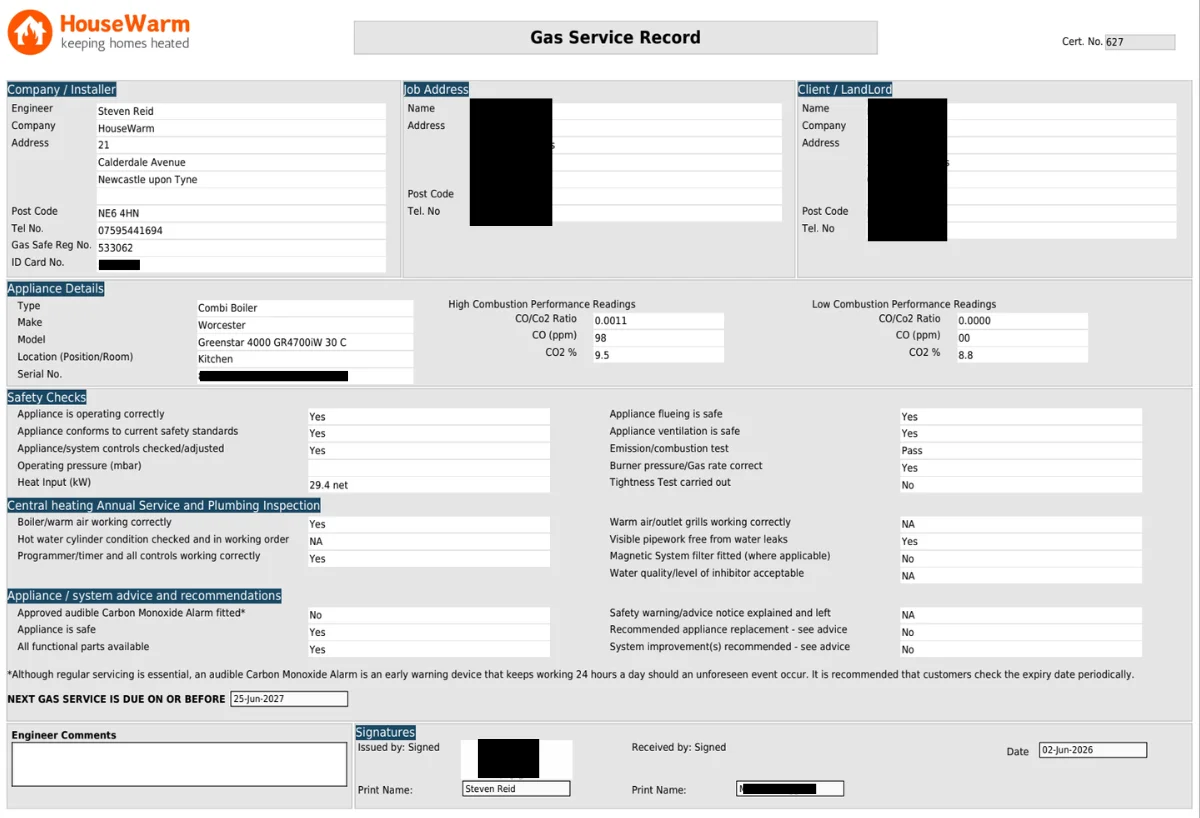
After completing the service, I provide a digital service record PDF by email containing the boiler information, checks, readings, and recommendations.
My digital gas service record includes details such as:
- Boiler make, model and location
- Combustion readings
- Heat input or gas rate information
- Boiler and control checks
- Flue and safety checks
- Magnetic filter condition where applicable
- Defects or recommendations
- Engineer and customer signatures
- Suggested date for the next service
The Gas Safe Register says an engineer can issue a service report detailing the checks performed and any resulting work, although providing a particular form of service report is not itself a general legal requirement.
Is a boiler service record the same as a gas safety certificate?
No. A boiler service record is not the same as a landlord gas safety certificate.
A boiler service record:
- Shows that maintenance and servicing have been carried out
- Usually focuses on the boiler being serviced
- Records relevant test results and recommendations
- Can help support the manufacturer’s warranty history
A landlord gas safety record:
- Documents a statutory gas safety check
- Can cover every landlord owned gas appliance and flue
- Must be completed annually for applicable rented properties
- Is commonly referred to as a CP12
The boiler can be serviced during the same appointment as a landlord check, but they remain different types of work and should be recorded correctly.
The official HSE guidance for landlords confirms that the gas appliances and flues provided for tenants require an annual gas safety check.
How much does a boiler service cost?
A one-off gas boiler service in the UK typically costs around £80 to £120, with an average price of roughly £100. Checkatrade’s current 2026 figures put a standard gas boiler service within that range.
Prices can vary quite a bit depending on where you live. As a rough guide:
- UK average: around £100
- Typical UK range: £80–£120
- London: often around £90–£135
- North East: commonly around £70–£110
- HouseWarm: £80
Location is not the only thing that affects the price. The boiler make and model, its condition, the type of service being offered and whether any additional fault-finding is required can all make a difference.
For customers in Newcastle and North Tyneside, my standard boiler service currently costs £80. Repairs, replacement parts and more extensive fault-finding are priced separately if anything is found during the service.
You can see full details of my £80 boiler servicing in Newcastle and North Tyneside.
Boiler service FAQs
Do they check radiators during a boiler service?
Not usually. A standard boiler service focuses on the boiler, its controls, flue, combustion and safety components. Radiators may be noticed while the heating is running, but bleeding, balancing or repairing radiators is normally separate work.
I occasionally get asked to bleed the radiators on a boiler service, which I do for no extra cost, but they are not checked as standard.
Does a boiler service include inhibitor?
Usually not as standard. A boiler service may include checking the condition of the system water or magnetic filter, but adding inhibitor is generally a separate maintenance task unless it is specifically included.
Do I need to turn the boiler off before a service?
I prefer that the boiler has been off for around 30 mins before I arrive to service a boiler, just so it’s not too hot to touch certain parts, but it’s not a big deal the heating is on when I arrive.
Can a boiler be serviced if it is not working?
No. A boiler needs to be working to complete a proper service, because the engineer must operate the appliance and carry out checks such as combustion testing, gas-rate checks and testing the controls.
If the boiler is not working, the fault needs to be diagnosed and repaired first. Once it is operating correctly, the boiler can then be fully serviced.
Is boiler servicing worth it?
Yes. Regular boiler servicing is definitely worthwhile because it helps keep the appliance operating safely and correctly, can identify developing problems before they become more serious, and may help prolong the life of the boiler.
Annual servicing also keeps the service history up to date and may be required to maintain the manufacturer’s warranty.